Learning about Weight

The Yr 3.1 students started talking about weight this week. The students learned about heavy and light things. They estimated weights of objects and chose which objects were heavier or lighter than others. They also used a balance to learn which object is heavier or lighter than the other as well as how to balance them. 

Weights were used to understand how heavy or light something is. Each student held each weight so as to feel the actual weight and compare it with other heavier or lighter weights. The students were particularly intrigued by the 1 Kg weight, especially when they found out that it is equivalent to 1000g. This was later compared it to a 1 Kg packet of spaghetti!

Submitted by Ms Sharon Calleja, Class Teacher

Jam Sandwich

In one of the Writing lessons the yr 3.1 students talked about instructions. The children learned what instructions are, what they are used for and where one can encounter them in everyday life.  They also learned about sequencer words such as first, next, then, etc., as well as imperative verbs. 

Students then focused on how to make a jam sandwich. The students participated in different leveled writing activities, varying from ordering a set of instructions, drawing pictures according to the given instructions, matching an instruction to a given picture, as well as writing the instructions themselves. 

To make this activity more meaningful, the students decided to actually make the sandwiches in class. The students got the necessary ingredients and made a sandwich with their preferred spread. Finally, they all enjoyed eating their creations!

Submitted by Ms Sharon Calleja, Class Teachers

Healthy Snack

The year 3.2 students made a Banana Swiss Roll during the week.  Students had so much fun doing this healthy snack. Indeed some of the pupils wrote down the instructions on how to make this snack at home.  They showed that   they had understood the English creative writing lesson – How to make a Jam Sandwich done during the week as they numbered their instructions, used sequencer words, bossy verbs and some even drew accompanying pictures.


Submitted by Ms Miranda Cauchi, Yr 3.2 Class teacher

Learning Doubles


The year 3.2 students were divided in groups and given interlocking cubes to make doubles of numbers from one to twelve.  Then, they had to write the answers on their mini whiteboards. By using the cubes all students had the same opportunity to learn.  When doing this activity pupils came to the conclusion that double is the same as when you multiply a number by two. 

To rehearse what the students had learned during the previous lesson they played the Slides and Ladders game. First, they rolled a die and using a marker moved that many spaces.  When they reached their box they had to work their sum (doubles).  Their peers had to check if they’re correct, if not they had to move back.  Students enjoyed going up the ladder but not going down the slide!! 


Submitted by Ms Miranda Cauchi, Yr 3.2 Class Teacher

Puzzle – Deciphering a Code

This week the students encountered a different type of puzzle during their fluency lesson. They had several numbers written on a card and they had to decipher what it said. In groups, they discussed what the numbers could mean. They thought they could be letters from the alphabet so they tried to decipher the secret message in groups, and they succeeded!

Submitted by Ms Sharon Calleja, Yr 3.1 Teacher

Run up towards Christmas

Novena03

The students are now preparing for Christmas. it is a school tradition to prepare special assemblies. At this time of the year a number of classes are involved in preparation of the Christmas Novena.Novena01

Through the Christmas novena students re-enact the story of the nativity, each day focusing on a particular character, The role of that character is explained, followed by Christmas carols.Novena02

Maths Tables…

table01

To rehearse the table of two, Ms Miranda, Yr 3.2 teacher, divided the class in four groups.  Each group was given a template of a house.  The groups had to work out the given multiplications and write them down on the paper.  After, members from each group, had to select the correct coloured roof, chimney, windows and door for their house by matching their answers (written on the template) with the ones written on the coloured paper.  Finally, they glued the coloured roof, chimney, windows and door on the template and drew the house.  Who knew learning tables would be so much fun?! table02

Opposites…

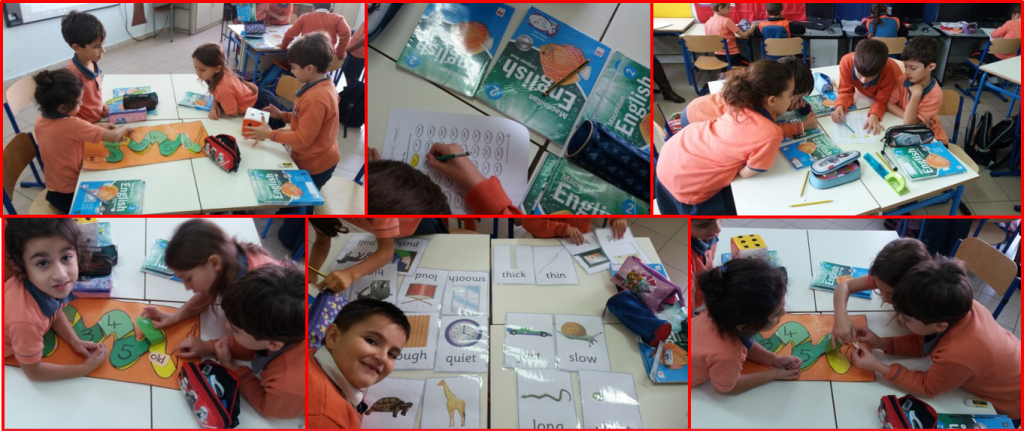
snake

The Yr 3.1 students of Ms Sharon have been learning “opposites”. After sharing the learning intention with the children and coming up with the success criteria together, the students worked in groups on 4 different activities involving opposites.  After a specified time, the teacher clapped twice and there was a rotation of activities so that each group could carry out all 4 activities.
In activity 1 (Matching Game) the children were given a set of flashcards with words and pictures. They had to find pairs of opposites.
In activity 2 (Snake Board Game) the teacher prepared a board game in the shape of a snake. The children had to throw a dice and uncover a word on the snake according to the number shown on the dice. After reading the word, the children had to state its opposite. They could then carry out self assessment by flipping the card with the word over to check their answer.
In activity 3 (Opposite Draw)  the students were given a handout with pictures and words. They had to draw something to show the opposite of the given pictures.
In activity 4 (Opposite Pie) the children were given a handout with rows of  pictures of pies and words in each pie. They had to read the word in the first pie of each row  and colour it in any colour of their choice. Then, they had to find the pie with the opposite word to the first one, in each row and colour it in .