Maths – Making 10

Whilst learning about pairs to 10, the tudents used bottle caps, in an investigation, to determine which are the number pairs that make 10. Using concrete objects helps the children to learn by doing. It also enables them to understand the concepts being taught better. Then, the students moved on to pictorial representations of the pairs to 10 and finally, they also worked out sums (pairs to 10) mentally as well as with written methods.

Submitted by Ms Sharon Calleja, Teacher (Yr 3.2)

Money

​Whilst learning about money the students in the year 3.2 class handled coins in order to observe and discuss their size, shape, colour as well as the amount that each coin represents.They handled coins to make different amounts of money. Then, they participated in a group activity during which they counted the amount of money in different purses. 

In another activity, the students used coins to make a given amount using the fewest coins possible.The students also investigated different ways to make the same amount of money. For instance, one could make 5c with five 1c coins, with two 2c coins and one 1c coin, with one 2c coin and three 1c coins, and so on.

During another day, the children used coins to determine how many they would need to make a specific amount.  For example, they used 10c coins to determine that they needed 10 of them to make €1 (100c).

Learning about money was so much fun!

Submitted by Ms Sharon Calleja, Teacher (Yr 3.2)

Science – Tasting Activity

After learning about the five senses, the year 3.2 students participated in different activities in order to use all of their five senses.  The activities included observing a picture in order to find hidden objects in it, paying attention to different sounds they heard and stating what they were, touching objects they use in class every day, comparing and contrasting things having different smells and determining which smells are harmful to us. Finally, they had a tasting activity.  The students could not see what they were tasting. They could only determine what it was by using their sense of taste and thinking about whether what they tasted was sweet or sour, whether it felt soft or crunchy whilst eating it and obviously by what it tasted like. The students tasted things like bell peppers, pretzels, lemons, chocolate, popcorn, biscuits and so on.  It was truly an activity that appealed to all our five senses!

Submitted by Ms Sharon Calleja, Teacher (Yr 3.2)

Healthy Breakfast Outing with Parents

During our outing to the B’Kara Home Economics Centre, the year 3.2 students learned about what a healthy breakfast consists of. They saw a short play about different types of breakfast and participated actively in discussions about which breakfast was the healthiest.

The students then took part in several learning activities and games about healthy eating. They also sang songs and learned about table manners. All the year 3 students ate a healthy breakfast which consisted of Weetabix with milk.

Submitted by Ms Sharon Calleja, Yr 3.2

Cleansing Campaign

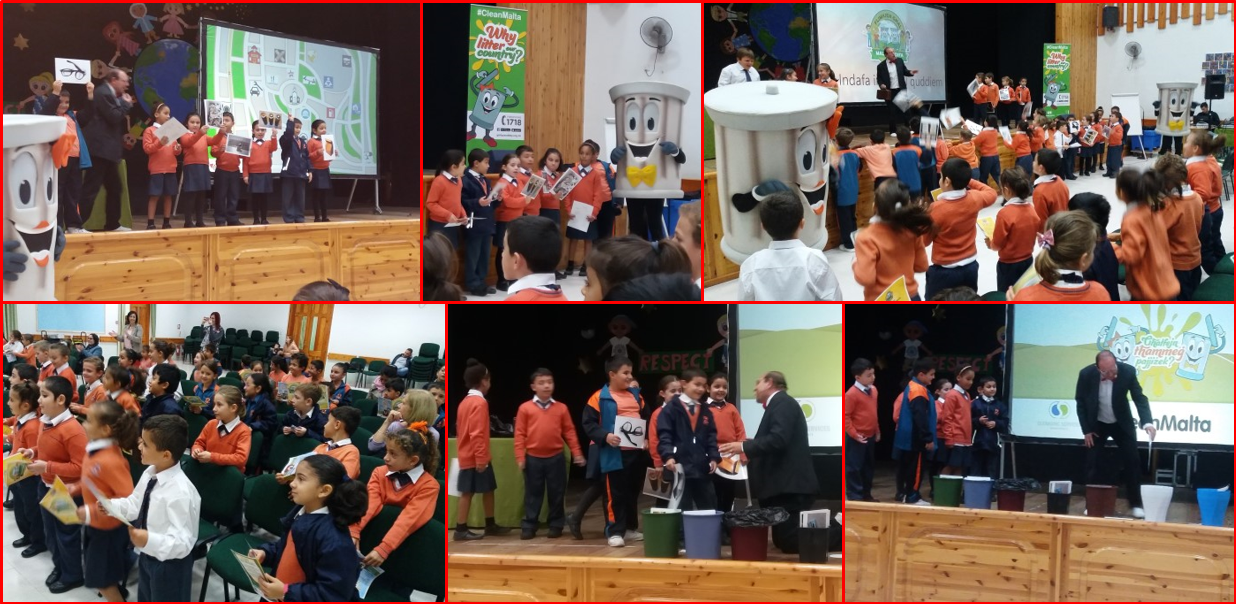
The year 3.2 students participated in the cleansing campaign which was held in our school hall. This activity was extremely interesting. The students learned about cleanliness in an interactive and fun way. They saw a short play, pretended to be investigators in order to solve a case and they sang along to the cleansing song. It was such an enjoyable activity!

Submitted by Ms Sharon Calleja, Class Teacher Yr 3.2 

Adding 10, 20, 30 and 40

Whilst learning about adding 10 and other multiples of 10 the year 3.2 students were visited by Incy Wincy spider. He showed them how to add 10 by jumping along on the number grid. He also showed the students how to add 20, 30 and 40 by using the number grid as well as other methods. One of these methods included using bottle caps to add 10 to a given number and playing a board game to add 10, 20, 30 and 40. The students also practiced adding 10, 20, 30 and 40 mentally and writing their answer on their mini whiteboard for immediate assessment and feedback.

Submitted by Ms Sharon Calleja, Yr 3.2

Plurals of Words ending in ‘y’

Students have been learning the plural of several nouns.  Indeed, during one week they learned that nouns ending in ‘y’ can be tricky; some drop the ‘y’ and add ‘ies’ while others add only an ‘s’ after the ‘y’.  To rehearse what they had been learning students were divided in groups.  One activity was a board game.    After throwing the dice, students had to pick the correct card number, read the sentence and change the noun in brackets into the plural.  Students wrote their answers on their mini whiteboards.  For the other activity students had to use the Bee-Bot.  Students chose and read one flashcard (a singular noun ending in ‘y’) at a time.  Then, they had to program the Bee-Bot properly so that it would stop on the correct plural of the given word.   

Submitted by Ms Miranda Cauchi, Yr 3.1

English Oracy Lesson

During an English Oracy lesson students were divided in groups.  Each group was given eight picture cards.  The class teacher explained that the picture cards which tell a storyand each group had to put them in the order they thought was right.  Then, pupils listened to the story for the first time.  While listening to the story pupils had to check and see if they had put the pictures in the correct order.  If not, they had to rearrange them.  Students listened to the story for the second time and rechecked their picture cards.  Finally, the pupils narrated the story using the picture cards as prompts.

Submitted by Ms Miranda Cauchi, Yr 3.1