Social Studies Fieldwork

As part of the Social Studies Curricula, the Year 3 students carried out a fieldwork in their school locality.  Students had to observed the environment surrounding the school.  Among other things, pupils discussed and noted the differences  and similarities between buildings,  compared the two main streets surrounding the school,  observed the different types of vehicles that passed from a main road and they also talked about the different shops one can find in the vicinity. Students recorded the information gathered in  their fieldwork booklet. 

Submitted by Ms Miranda Cauchi, Yr 3.2 Class Teacher
Literature and Oracy Lesson

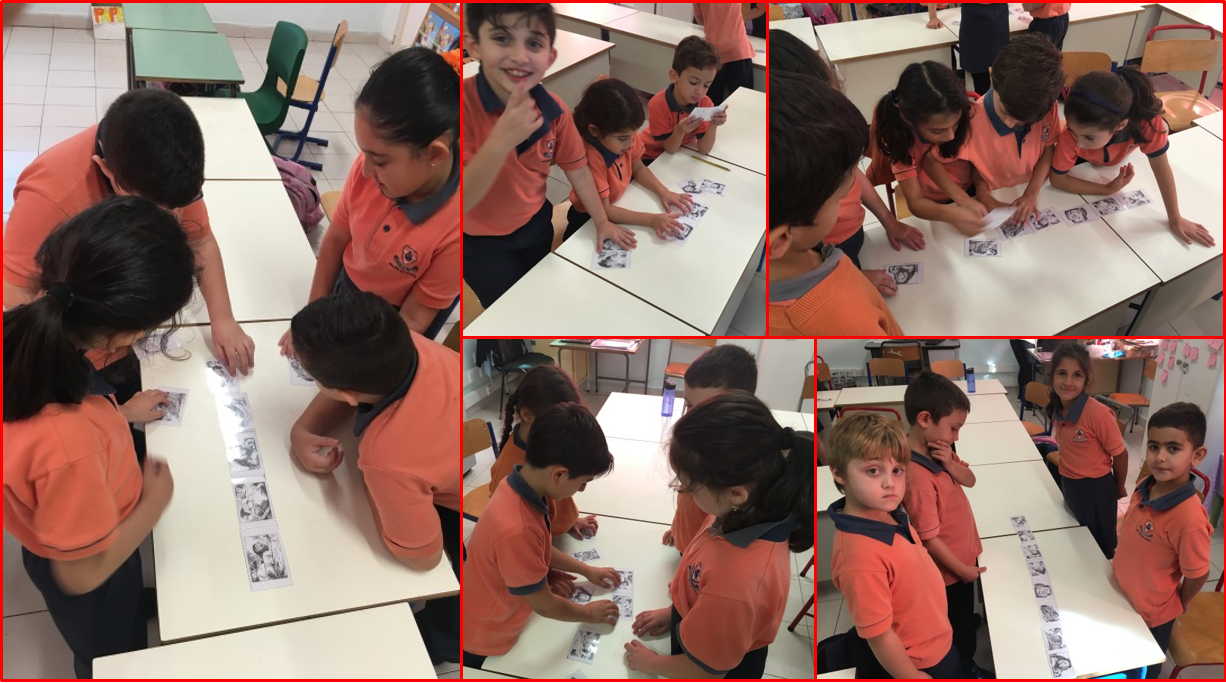
The Year 3.2 students were divided in groups.  Each group was given a set of picture cards of the story The Lion and the Mouse.  Students had to put them in the order they think was right.  Students displayed the cards on the table.  Then, students listened to the story and checked if their cards were in the correct order.  Students listened to the story again and a  worksheet was given to them.  Pupils had to fill in the table (integrated with a Math lesson) by ticking under the correct heading.  Finally,  in groups, students narrated the story (picture cards were used as prompts).

Submitted by Ms Miranda Caucchi

Five Senses

Five senses stations were set up in class.  Children had to guess what the objects were by using their senses.  They used their sense of touch by touching the different objects, one at a time, found in a plastic tray.  Their eyes were covered again, with a piece of cloth, and students had to guess what the objects were bu using their sense of smell.  Students had to taste the different types of food presented to them.  Finally, pupils listened to sounds from the interactive whiteboard and had to guess what they were.  When participating in these sessions students were able to describe the object/s by using language related to the five senses, for example: soft, loud, sour, sweet, salty, rough etc…  In so doing, this lesson was also integrated with the English Oracy lesson.

Submitted by Ms Miranda Cauchi, Yr 3.2 Class Teacher

Comparing Numbers

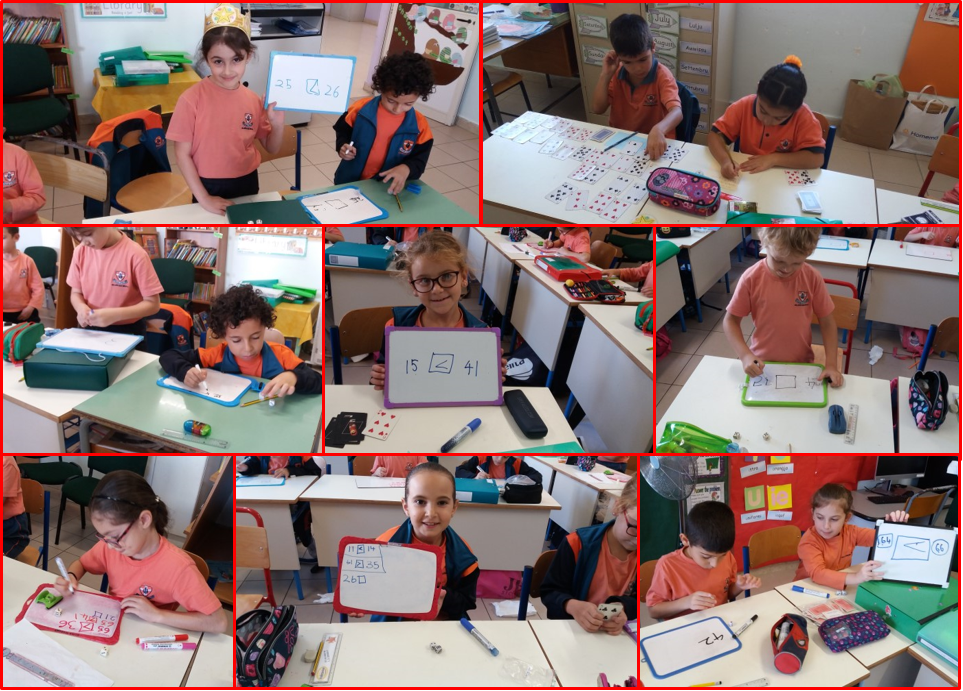
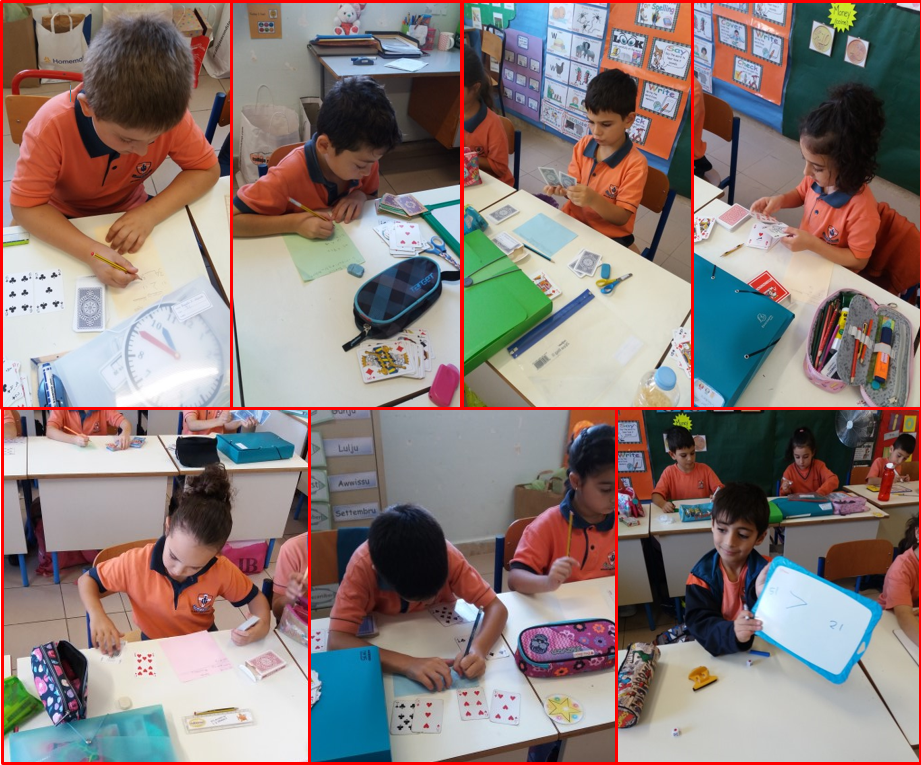
In the photos the year 3.1 students are seen participating in two different activities involving creating 1-digit and 2-digit numbers with dice and later with playing cards.  They created different amounts and types of numbers, according to their abilities, and then, they compared the numbers they created by using the symbols <, > or =.

Submitted by Ms Sharon Calleja, Class Teacher

Subtracting multiples of 10

During another number of Mathematics lessons, the year 3.1 students learned how to subtract 10 and other multiples of 10 from a 2-digit number.  The students enjoyed watching songs and videos about this topic as well as participating in hands-on activities to take 10 away from a 2-digit number.  In the photos they are seen participating in four different grouped rotating activities during our final lesson about this topic.

Submitted by Ms Sharon Calleja

Subtracting

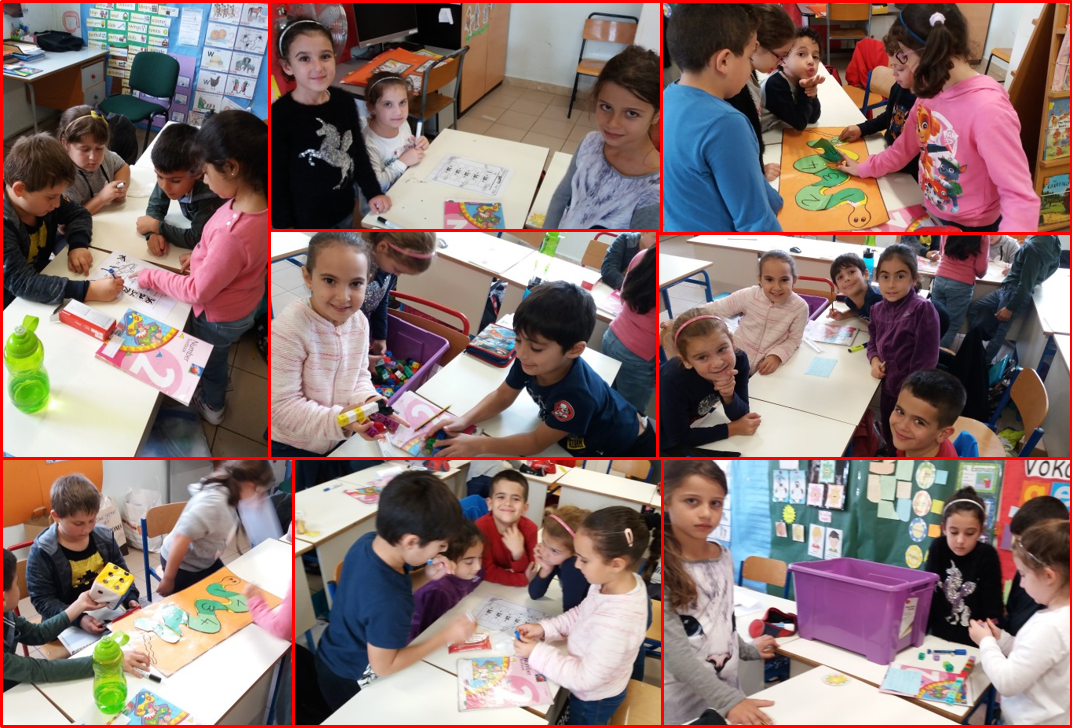
The year 3.1 students were learning about different subtraction strategies during different Mathematics lessons.  They subtracted numbers by counting back as well as by counting on.  The topic was introduced with concrete situations involving hands-on activities.  The students later moved on to pictorial representations of taking away and finally, they practiced the abstract part of subtracting number sums.  In the photos they are seen using interlocking cubes to help them work out subtraction sums.

Submitted by Ms Sharon Calleja, Class Teacher

The Fox and the Crow – Literature and Listening Activity

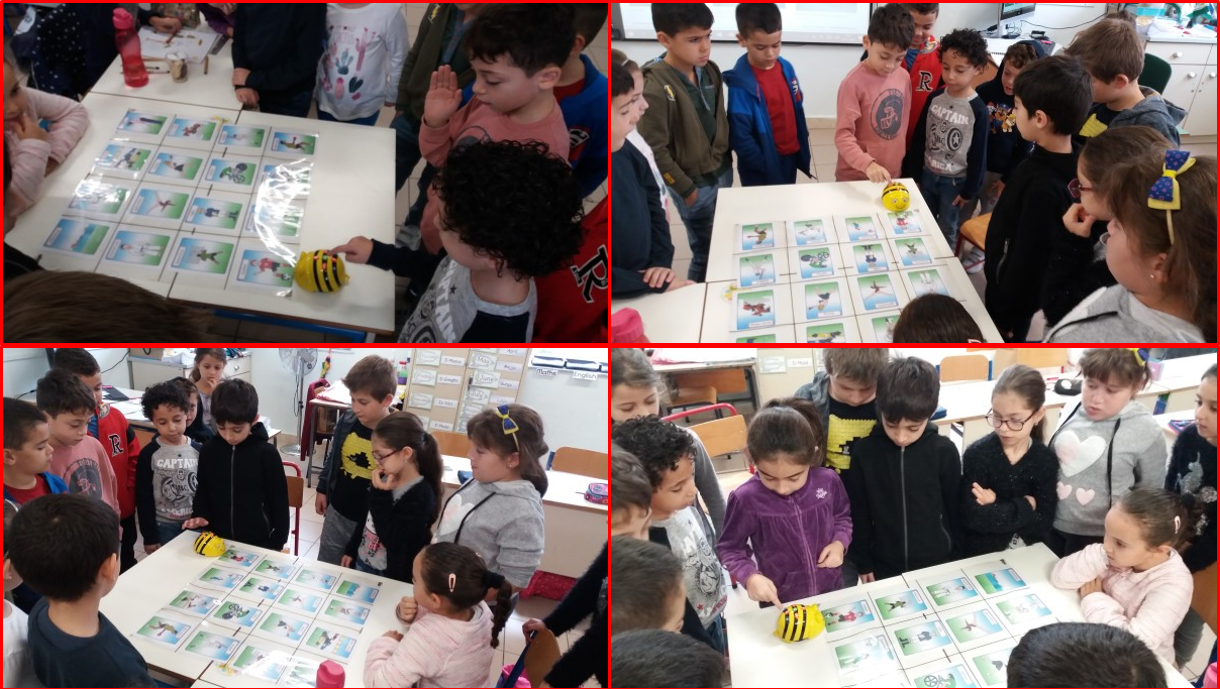
Year 3.1 students are seen participating in an activity in groups.  This was done as part of their Listening and Speaking lesson which was integrated with Literature. The students were given a set of pictures depicting the story The Fox and the Crow.  They were asked to observe and discuss what the pictures depicted.  Then, the students put the pictures in chronological order according to their observations and discussion.  Finally, the students listened to the actual story and checked the order of their pictures to determine if their ordered matched the order in the story.

Submitted by Ms Sharon Calleja, Class Teacher

Mġarr Fieldwork

As part of their Social Studies learning programme as well as Continuous Assessment, the year 3.1 students took part in a fieldwork inside our school, around the school as well as in places of interest in Mġarr.

The students enjoyed listening to sounds around them, noting different types of buildings, fields and rubble walls, comparing a noisy street to a quiet one, observing and talking about different types of shops found in Mġarr as well as the church and patron saint, a recreational area for children in Mġarr and observing different cars that passed in a particular street and recording the information gathered in their fieldwork booklet.

It was truly a wonderful educational experience which was enjoyed by the students and teachers as well!

Submitted by Ms Sharon Calleja

Science Investigation: Will it float or sink?

To begin the lesson the teacher asked:  What is science?  What do scientists do?  A discussion ensued and then a video was shown to the pupils. To learn more about the scientific process they took part in an investigation.  The teacher showed the students two eggs and posed the following questions:  Will the eggs float or sink?  Why do you think so? Students stuck a sticky note under the headings:  Will float/ Will sink.  Some students were undecided as they thought that one egg could sink while the other could float. Therefore, they stuck their sticky note in the middle.  I poured some water in the glasses.  After, students explained why they thought the egg would sink or float. 

Some students observed the eggs and explained that since one egg looked larger than the other it would sink while the other would float.  Others pointed out that the egg shell of one egg could be thicker than the other and therefore one may sink and the other may float.  Both eggs sank, but one sank to the bottom and sat on its side while the other sank but floated at an angle.  The teacher asked the question:  Which egg is fresher?  Students observed ad discussed.  The egg that sank to the bottom was fresher.  We also discussed that if the egg was not fresh it would float because when an egg ages, the shell becomes more porous allowing air to flow through. The more air entering through the shell, the larger the air cell becomes.  The air sac, when large enough, makes the egg float.  Students were eager to tell their parents/guardians about this investigation and their findings.

Submitted by Ms Miranda Cauchi, Yr 3.2 Teacher