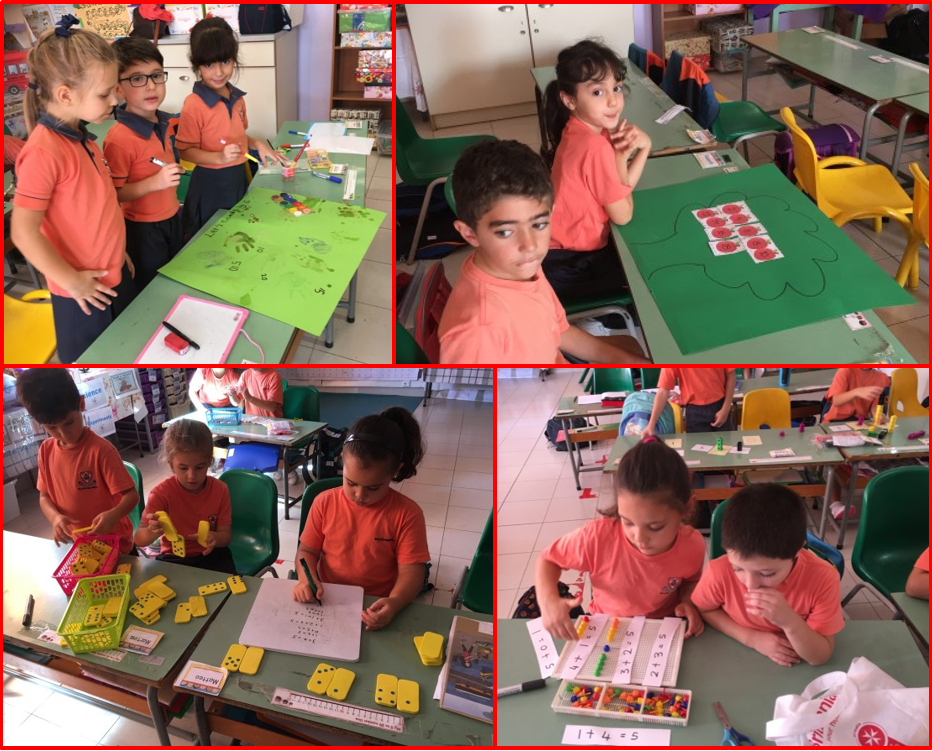
Fractions

Students have learnt about halves, quarters, thirds and eights. After sharing the learning outcomes and the success criteria, students had a presentation where they had to identify which shapes are divided into equal parts, and the fraction of each part being shaded. During group work the students had to divide their shapes into equal parts and shade their parts according to the fraction being told.

Submitted by Ms Mathea Vassallo, Yr 4.1 Teacher


Making Maths Matter…

Learnign Maths can be fun. Students explored different ways of making pairs of 5. Then they proceeded to counting in fives.

During one of the lessons students explored the difference between tall / short, and long short. Using visual aids and specifically designed cards, the students worked together to learn about spatial awareness.

Sorting numbers in order up to 30 has never been easier. Students were given various tools to practice sequencing numbers, including lacing, sorting and use of Bee-bot to learn about sequencing while coding.

During another lesson, students worked in pairs to learn about pairs, counting in 2s and distinguishing between tens and ones.
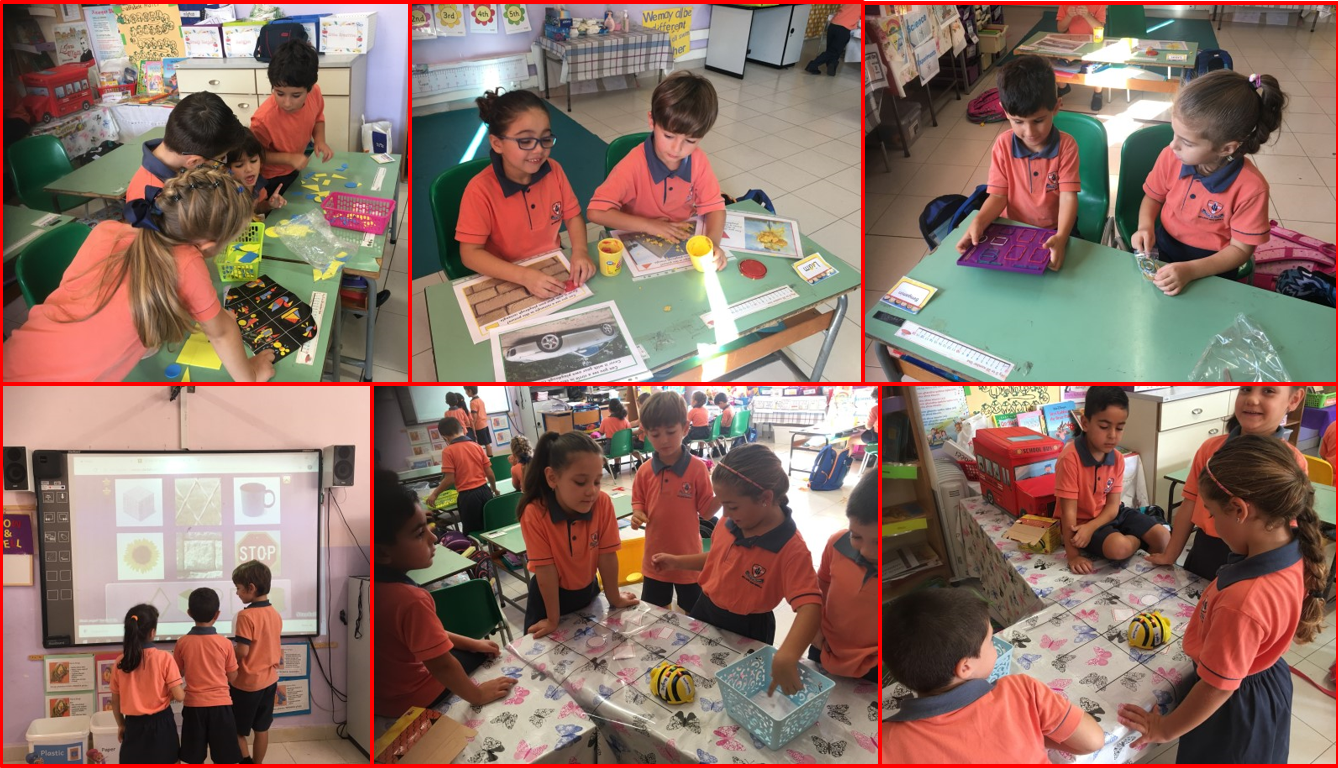
 In a classroom buzzing with fun students learned about shapes through various activities. Bee-bot was used to learn coding while finding the correct shape. Shape templates were used to create pattern, thus exploring the edges of shapes. Geoboards were used to create shapes and plasticine was used to build templates of a brick wall using rectangles.

Submitted by Ms Stephanie Azzopardi, Yr 2.2 Class Teacher

Numbers up to 100

The Year 3.2 students have been learning about numbers .  Students were engaged in various hands-on activities so that they were  able to read, write and order numbers up to 100 in figures and words.  They also sang along to a video song and played various online games.

Activity 1:  Ordering Numbers – In pairs, students had to choose the correct peg/s to continue the number sequence found on the lollipop stick.

Activity 2: Matching numbers – figures with words

Students used their number cards (numbers in figures) from their Maths Toolbox to play Bingo.  The teacher drew out a number card from a bag and called out random numbers from 1 to 100.  Students had to check and see if they had the called out number written on their Bingo sheet.  If students had the number, they placed the correct number card on the corresponding number name found on their Bingo sheet.

Submittted by Ms Miranda Cauchi, Class Teacher

Place Value

The Concrete, Pictorial, Abstract (CPA) approach of teaching in Math is being used in class so that students develop a deep and sustainable understanding of this subject. Students participated in several hands -on activities using diverse manipulatives, such as interlocking cubes. 

They also used 10c and 1c coins as well as straws from their Maths Toolbox to understand better the concept of tens and units. They were shown videos and PPTS and played online games and other activities on the interactive whiteboard.  Then students were able to represent the place value of any given number in a pictorial way and later work out the related tasks using only numbers.


At the end of the topic students were given the chance to practise what they had learned during these sessions as they participated in various learning stations.  In one of the activities involved students had to programme the Bee-Bot to stop on the correct flashcard answer.  In doing so, our class also participated in the European Code Week.By using the CPA all students were able to understand and recognise the place value of any digit in a whole number up to 100 (Learning Outcome 5.1.3).

Submitted by Ms Miranda Cauchi, Yr 3.2  Teacher

Tens and Units

Students learn better when they have the opportunity to manipulate real life objects to help them understand mathematical concepts better.  

That is why the year 3.1 students take part in such activities on a daily basis during their Mathematics lessons.

In the photos, the students can be seen using resources from their Maths Toolbox to help them understand Tens and Units better. They watched videos, songs and PowerPoints about the topic and they played online games too. They also participated in several hands on activities involving manipulatives, that included base ten blocks, 10c and 1c coins as well as straws, in order to learn about tens and units in a concrete way.  Then, the students moved on to representing 2-digit numbers in a pictorial way and finally, they worked out related tasks involving the writing of numbers, thus adopting the concrete, pictorial and abstract (CPA) mode of teaching in our lessons.

Sharon Calleja, Class Teacher

Flat shapes…

Today’s Math lesson was about flat shapes and their properties. First students had a presentation where they had to try and guess the name of the hidden flat shape. Then students had time to discuss the properties of the various shapes. Finally they had the opportunity to engage in hands-on experience using geoboards to construct and investigate the properties of plane shapes.

Submitted by Ms Mathea Vassallo, Yr 4.1

Learning Number Names

Students learning about writing numbers in words.  After watching a video and singing along to the numbers song, students played a game with the bee bot to match numbers in figures with those in words. Finally, the students played an online game to consolidate number names.

Submitted by Ms Sharon Calleja, Yr 3.1

Full Speed Ahead before Closing the Scholastic Year…

Although the scholastic year is coming to an end, the Year 2 students of Ms Stephanie Azzopardi are still working full speed ahead to get the best of their journey. Above students can be see working together learning pronouns during Maltese, and building words using plastic alphabet letters.
During one of the school outings the students watched a play about believing in oneself. Following the play, the students made some craft related to the activity.Following a Social Studies lessons about typical Maltese food, the students prepared a Maltese Ftira with ‘kunserva’ (a tomato paste) and olives.

Above the students are working together by creating addition sums using number beads. They also explored what happens to numbers when using 10 more and 10 less or 1 more and 1 less.

Mathematics outside the classroom

The Year 3.1 students have been learning about hours, minute and seconds.  To better understand how long a second or a minute is they had to do various activities.  For example:  They had to see how many times they could skip a rope, run around the garden and go up and down the stairs in one minute.  Such an activity was also linked to Physical Education.

After writing down their results, students had to compare them with a friend.  They realized that their results were different as is their agility when doing such activities.

Submitted by Ms Miranda Cauchi, Yr 3.1

Capacity

The year 3.2 were busy learning about capacity by participating in hands-on activities to help them understand this topic in a more concrete way.The students filled different containers with coloured water to learn about litres and millilitres.  They took part in several investigative tasks, such as pouring 1L of water into containers of different sizes, finding out how many containers of a specific amount needed to be poured into a 1L container to fill it up, reading the scale on different containers to find out how much liquid was poured in them, as well as pouring two different amounts of liquid into a larger container to find their total and recording their answers by drawing the capacity on a given jug.

Submitted by Ms Sharon Calleja, Yr 3.2