Doubling

The year 3.2 students learned about doubling in a fun way!  They used paint to discover the doubles of numbers up to 10 and then beyond.  Coins helped them to discover the doubles of different amounts of money.  They also took part in other educational games and activities to become doubling champions!

Submitted by Ms Sharon Calleja, Yr 3.2

Division

To understand the concept of division and to relate what we do in school with the outside world children did a hands-on activity.  Each group was given five empty boxes of Smarties.  On a given plate they were given some Smarties as well.  Students had to find out how many boxes they needed.

During other lessons students played various games on the interactive whiteboard.  For example:  Sharing fruit between two children.

Whilst doing these activities children used known number facts to carry out simple division and halving.  Students also understood the operation of division as repeated addition.  Furthermore children also associated division as equal sharing.

Submitted by Ms Miranda Cauchi, Yr 3.1

Doubling & Halving Scavenger Hunt

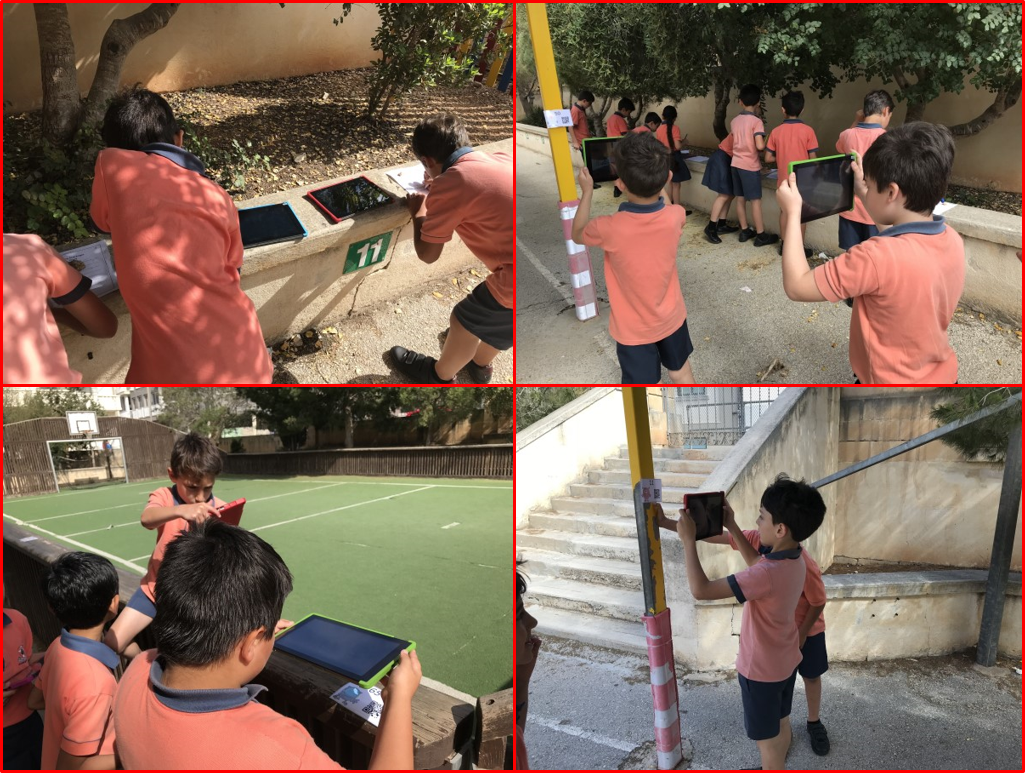
The Yr 4.1 class of Ms Angelique Attard had a maths lesson with a difference. The children were divided into groups and participated in a scavenger hunt held in the playground.

The children really enjoyed themselves using their tablets to scan the provided QR codes which had been distributed around the space and writing down the sums on a recording sheet. This activity helped the children to move around while learning. The winning team was also rewarded!

A learning experience for Yr 2.1

The Yr 2.1 students of  Ms Stephanie Azzopardi have embarked on an eTwinning Protject. In the above photos the students shared their experience with their partners from Greece by showing them how they learn shapes with the help of techonology using a Beebot. In this joint partnership both partners are using Beebot in teaching and learning.

Students learn counting in 2s and 3s using interlocking cubes, numbers, bee-bot and colourful pins to create a pattern using the Concrete, Practical, Abstract Approach.

Bark rubbing fieldwork held in Buskett  during the School Marathon Walk.

Capacity – measuring large bottles, a tin and a jug.During this session students used vocabulary to label: full, empty, nearly full, nearly empty, half full and half empty in a very practical and hands-on manner.Clocks – matching activity, use chalk to create your own clock! Students enjoyed this outdoor session in the school yard using hula hoops and chalk to create their own clocks.

During a visit at the Inquisitor’s Place in Birgu, the students enjoyed a Story telling andcooking session during which they prepared the typical pastini tar-raħal.

Students enjoying Sports Day organised by the PE teachers and the Sports Promotion Unit.

Submitted by Ms Stephanie Azzopardi, Yr 2.1

Odd and Even Patterns

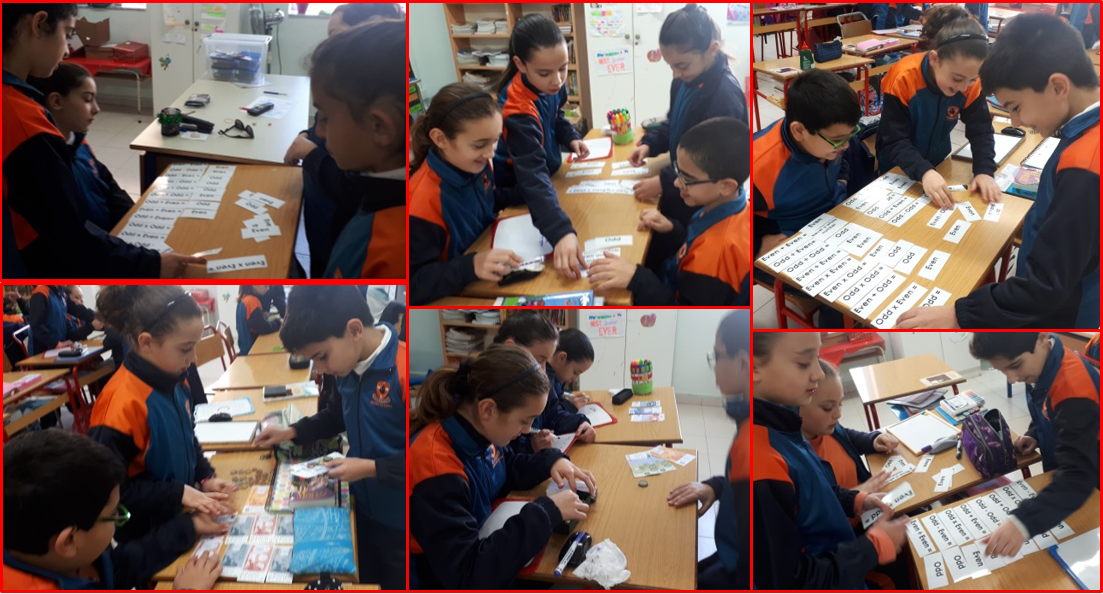
Students participated in a number of activities during an Odd and Even patterns lesson. The students were given a set of cards and they had to match them according to whether the answer is odd, even or never a whole number. A discussion followed, with examples. Finally an activity using money was carried out. The same patterns were explored by the students through money. 

Submitted by Mr Matthew Cassar, Yr 6.1 Class Teacher

3D shapes…

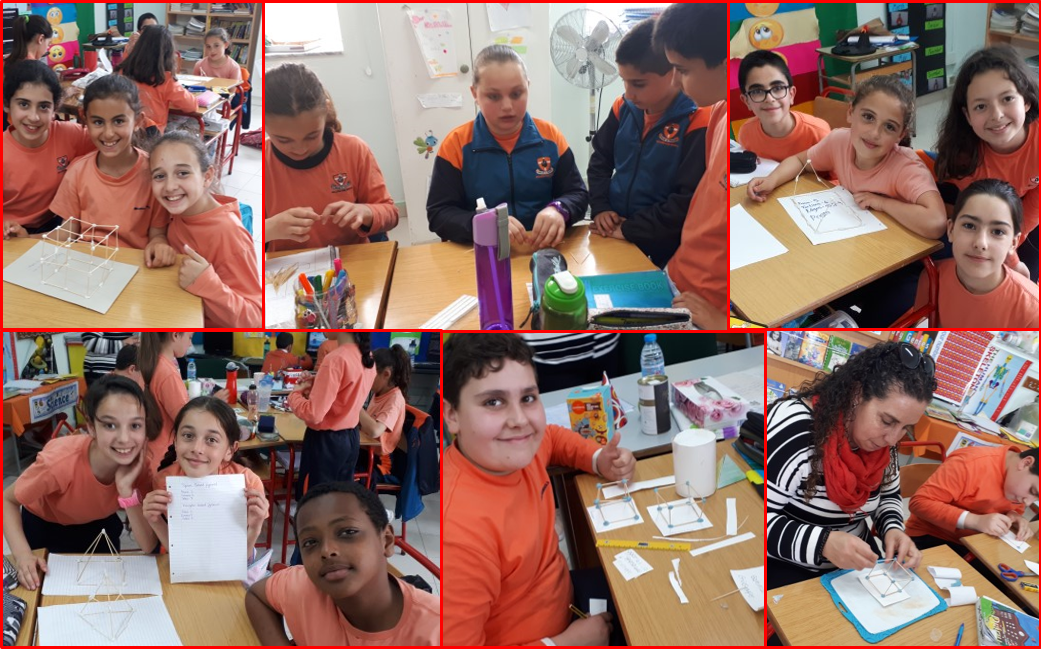
These are some photos of an activity carried out with the Yr 6.1 students during a Maths lesson. The children were asked to create 3D shapes using blue tac and toothpicks. After doing so, the number of vertices, faces and edges of each 3D shape were discussed. Everyone enjoyed this activity, including the learning support educator.

Submitted by Mr Matthew Cassar, Yr 6.1 Class teacher

Literacy and Mathematics

Students were presented with the story The Doorbell Rang. Each group was given 2 paper plates and a packet of biscuits/sweets. The story began with 2 children taking 6 biscuits each.
First, the students had to find the total amount of biscuits Mum had baked. Quickly students came up with the answer by using multiplication or doubling. They also pointed out that the children (from the story) took the same amount of biscuits. Students realized that the learning intention of the lesson was division (sharing).  The story continued with more children coming to the house to eat the delicious cookies Mum had baked.  Therefore, students had to get more plates and share the biscuits/sweets equally. After the story ended the pupils had to write down the division problems.  


This helped students understand the concept of division.

Submitted by Ms Miranda Cauchi, Yr 3.1 Teacher

Multiplication

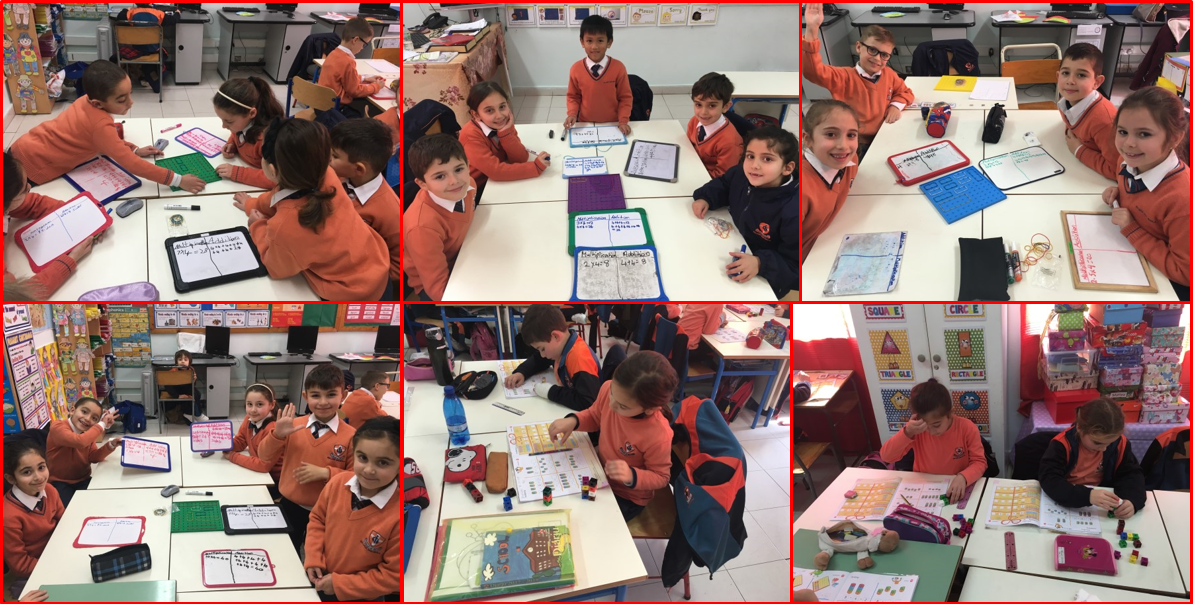
In order to understand the operation of multiplication as repeated addition children took part in various hands on activities.   Students are engaged and understand better when using manipulatives.  As the photos show, they enjoy learning this subject. Maths can be fun after all 🙂

Submitted by Ms Miranda Cauchi, Yr 3.1 Class Teacher

Estimation

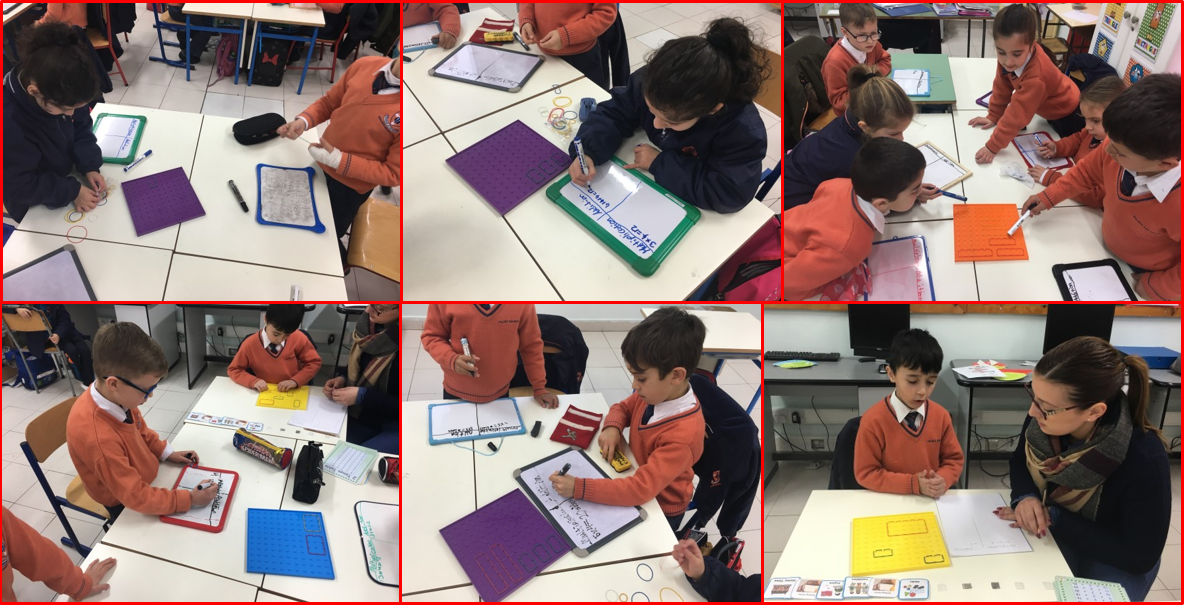
The class was divided in stations.  Each station was given a container filled with the following: coins, pins, paper clips and butterfly pins.  Students had to write (on their mini whiteboards) how many they thought there were in each container without counting; thus estimating (guessing).

After, students were asked to say what made them guess that number (their observations).  Some noted that since coins are larger than pins they came to the conclusion that there were less coins.  Others noticed that even though two of the containers were the same, one was filled slightly more.

Finally, they counted the objects found in each container to check their estimate.  Furthermore they linked what they were doing in class with the outside world as they noticed that sometimes in competitions people have to estimate how many balloons, tickets …are there in a box. 

Submitted by Ms Miranda Cauchi, Yr 3.1

Fractions – One half Year 3.1

Each group was given some plasticine and cooking cutters.  Each member of the group had to divide his/her shape in half.  The students pointed out that both halves had to be of the same size and when they were once put together they made one whole.  Some students also realized that when the halves of the shapes are halved again they become quarters.  Then, each group had to cut the given paper shapes in half and glue them on their copybooks.

In another lesson, in groups, students had to tick whether the pictures of the given real life objects were divided in half.  They also had to divide other real life objects in half and draw an object/thing and hen divide it in half as well.  Students also did similar activities on the IWB. 

Submitted by Ms Miranda Cauchi, Yr 3.1