Capacity


This week we talked about capacity in Maths. The students learned that capacity is the amount of liquid a container can hold. They also learned about the units we use to measure capacity, namely litres (L) and millilitres (ml). They learned that we use ml to measure small quantities and L to measure large quantities. They also learned that 1 litre is equal to 1,000 millilitres.  The students also practiced making estimations of the capacity of different containers as well as reading different amounts of liquid on a scale.  They did all this by means of hands on activities since we used different containers filled with water. We put green food colouring in the water so they could read the capacity clearly on the scale on each of the different containers. We estimated and poured different quantities of coloured water in different sized containers. We experimented with different containers to see if they could hold more or less than 1 litre. We even saw how many of a particular container were needed to fill up a larger container. For example, they learned that they needed 2 500ml containers to fill up a 1litre container.  The students also saw different sized 1 litre containers to learn that even though they looked different, they all had the same capacity. It was a fun learning experience and the students enjoyed pouring the coloured water in the containers!

Submitted by Ms Sharon Calleja, Yr 3.1 Teacher

Counting in 3s, 4s and 5s

In class the students were learning how to count in 3s, 4s and 5s. They started learning the x3, x4 and x5 tables as well as counting on in 3s, 4s and 5s from any given number. In one of the activities we carried out in class, the children were given a flashcard of a cupcake with a number on it. Each student had a different number. They stood in order, according to the particular times table (x3, x4 and  x5).

Submitted by Ms Sharon Calleja, Yr 3.1 teacher

Learning about Weight

The Yr 3.1 students started talking about weight this week. The students learned about heavy and light things. They estimated weights of objects and chose which objects were heavier or lighter than others. They also used a balance to learn which object is heavier or lighter than the other as well as how to balance them. 

Weights were used to understand how heavy or light something is. Each student held each weight so as to feel the actual weight and compare it with other heavier or lighter weights. The students were particularly intrigued by the 1 Kg weight, especially when they found out that it is equivalent to 1000g. This was later compared it to a 1 Kg packet of spaghetti!

Submitted by Ms Sharon Calleja, Class Teacher

Learning Doubles


The year 3.2 students were divided in groups and given interlocking cubes to make doubles of numbers from one to twelve.  Then, they had to write the answers on their mini whiteboards. By using the cubes all students had the same opportunity to learn.  When doing this activity pupils came to the conclusion that double is the same as when you multiply a number by two. 

To rehearse what the students had learned during the previous lesson they played the Slides and Ladders game. First, they rolled a die and using a marker moved that many spaces.  When they reached their box they had to work their sum (doubles).  Their peers had to check if they’re correct, if not they had to move back.  Students enjoyed going up the ladder but not going down the slide!! 


Submitted by Ms Miranda Cauchi, Yr 3.2 Class Teacher

Maths… solid shapes

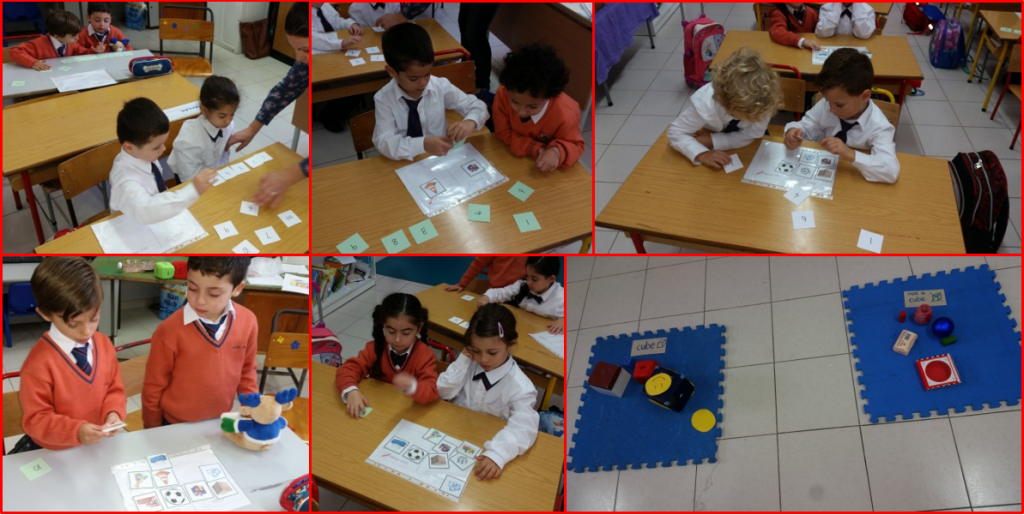
mathsThe Yr 1.1 students of Ms Louise have been learning about the properties of solid shapes. During today’s lesson they had to sort between cubes and cuboids. Students made use of Bee-Bot to sort shapes and later worked in pairs to sort objects according to whether the shape was a cube or a cuboid. The classroom was bustling with learning and students really had a great time.


Exploring 3-D Shapes – The Cube

cubeThe Yr 1.2 students of Ms Marilyn had an interesting lesson during which they learned about 3D shapes, focusing on the cube. The lesson was introduced by revise the characteristics of a square. Then the teacher told the students the story of 6 squares who joined together to form a cube. Students had various activities to learn by doing about the features of cubes… sorting objects, sticking square faces to the 6 faces of a cube, putting play corner on the 8 corners of a cube and counting the edges.


Maths Tables…

table01

To rehearse the table of two, Ms Miranda, Yr 3.2 teacher, divided the class in four groups.  Each group was given a template of a house.  The groups had to work out the given multiplications and write them down on the paper.  After, members from each group, had to select the correct coloured roof, chimney, windows and door for their house by matching their answers (written on the template) with the ones written on the coloured paper.  Finally, they glued the coloured roof, chimney, windows and door on the template and drew the house.  Who knew learning tables would be so much fun?! table02

Fractions…

fraction

The year 4.2 students of Ms Mathea have learnt about halves, quarters, thirds and eights. After sharing the learning outcomes and the success criteria, students had a PowerPoint presentation where they had to identify which shapes are divided into equal parts, and the fraction of each part being shaded. During group work the students had to divide their shapes into equal parts and shade the parts of their shapes according to the fraction being told.

Learning Maths through Play…

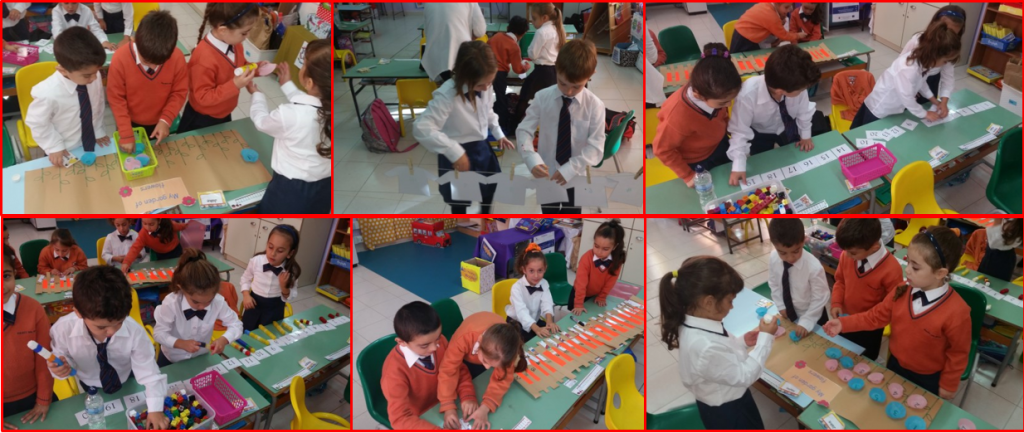
OrderingThe Yr 2.2 students of Ms Stephanie have been learning about ordering numbers and finding the number that falls in between. In the above activities students had to sort flowers according to number order, place numbers on a ladder in order, hang numbers on a “washing line” in order, and build towers using blocks and placing them in order from smallest to largest.


Length Activities…

The Yr 3.1 students of Ms Sharon learnt about length and the different units used for measurement. They learnt how to estimate lengths of objects as well as decided which unit would be most suitable to best measure a given object. Finally the students learnt how to measure and draw lines using a cm ruler.

Length01

In the first activity the children measured the length of objects given on cards (glue stick, pencil, etc.) followed by actually measuring the length of real life objects found in the classroom such as the length of a book, pencil, crayon, chair, door, etc.

Length02
In the second activity the students talked about the story of Pinocchio and focused on the part where his nose grew when telling lies. Each group was given a flashcard with the picture of Pinocchio and they had to measure the length of his nose. The length of the noses were different for each group, thus, there was a rotation of cards until all groups measured all the different lengths of Pinocchio’s nose.