The year 3.2 students were visited by Timothy the Teddy bear who taught them about prepositions. He showed them pictures and actually moved around in our classroom and used his box to help the students understand certain prepositions , such as in, on, under, above next to and so on, better. The students took part in a variety of activities such as selecting a card with a preposition written on it and moving the Bee Bot on the picture showing that particular preposition. They also made books about prepositions and made them part of our class library. The students also played mini bowling to uncover a preposition and use it in a sentence of their own to show that they understand its meaning.
All class joined forced on World Book Day to celebrate the importance of books and to instill a love for reading. Teachers prepared a number of activities inspired by various books. Handa’s Surprise offered the students as taste of Africa and fruit that grows in this continent.
Goldilocks and the Three Bears helped kindergarten students to learn about size. Activities related to this book required students to sort objects according to size.The Ants and the Grrasshopper provided the set up for children to learn about ants and their importance in maintaining healthy soil. Goldilocks and the Three Bears allowed kindergarten students to explore the value of 3 while learning about size. Children enjoyed preparing masks which were use to role play the story.Below is a short video clip of of the teacher narrating part of the story to her students.
We’re Going on Bear Hunt was the book chosen by Ms Marija. Students enjoyed the story and then prepared masks and a collage, while role playing the story and sequencing the story.
Ms Felicia made use of the book Buxu Jsib Teżor to capture the students’ imagination. Later the students enjoyed their fishing game while learning about value and sequence of numbers. Goldilocks and the Three Bears featured in another class. During this session students role played the story and played a number of games related to this story including picture lotto, sequencing cards, sorting, etc.The Very Hungry Caterpillar, toegether with Beebot, helped students to enhance their literacy skills. Students enjoyed sorting the various food eaten by the caterpillar on the flannel chart.
After reading the story The Tiger who came to Tea the children created an invitation for a tea party. Afterwards they created different food items for the party using play dough. When the activities were over they chose a book from the library and spent a few minutes reading in silence. The Very Hungry Caterpillar featured in Yr 1. Students had to retell the story while helping Beebot trace his way around in the correct sequence.Żaqqinu jagħżel x’jiekol… Żaqqinu Jagħżel x’Jiekol set the pace for a number of activities including a game whereby students had to select healthy and unhealthy food; role play showing healthy eating and physical activity; Beebot to match food to the place from where it can be purchased; reading outside the classroom; Maths lesson about counting in 5s / odd and even and Maltese lessons about “dik/dak/dawk”.
Students in Yr 2.2 discussed what would happen if fairy tales got mixed up. After reading a fairy tale twist, The Big Bad Werewolf students had 2 create their own fairy tale twists and share them with classmates.
After showing the students some books Ms Miranda used to read in both languages when she was young, she when on to read them a short story. Teacher read a fairy tale eBook to students. The students discussed ‘What is a fairy tale?’ and the elements of the story: characters, setting and plot. Students planned their story. Characters and settings word mats were given to help them out. They has to think about a good title for the book. Pupils read and wrote their story.
Year 3.2 created their own book after discussing fairy tales and story elements as well as planning their work by means of drawing and/or writing. The children also created the front cover and some also included the blurb.During the day all students participated in 10 minutes during which they had to drop down everything and read a book. Year 4 students enjoyed wearning costumes of their favourite character while reading out their favourite stories.
Students wore a costume that portrayed their favourite character of their favourite book. They talked about the title, author, illustrator and the plot of the story. They also read part of their favourite chapter and discussed with the rest of the class why this is their favourite book.Yr 5.1 students wrote alternative endings to stories. The stories were published using different media including drawing, online, etc.
Planning had started prior World Book Day. Students used tablets and the app Simple Mind to plan their work.
Finally the students used Lego story starters to build a scene from their stories and to create an alternative ending.Yr 5.2 students browse through various narratives. They made use of the app Simple Mind and their tablets to brainstorm ideas for creating their own story line. During the last 2 months Mr Matthew was carrying out story telling lessons with his students. He read one his favourite childhood books Free Lance and the Lake of Skulls. Once the story was over the children prepared props from recycled materials to act out one of their favourite scenes. A wheel spinner with questions related to the story was used for students to reflect on the story itself.
Following curriculum time meeting with HoD, students choose a scene from the story Free Lance and the Lake of Skulls . The students wrote a script for the chosen scene and presented it to their classmates.The Year 6.2 students played musical chairs. Different books where place on chairs. When music stopped playing the students sat on the chair in front of them and read from the book resting on that chair.
Well done to all for making World Book Day a huge success 🙂
Today was a wrap for the gardening sessions held by Ms Nicky over the past week. Three classes successfully completed their sessions and they are now officially recognised as our school gardeners.
The students have been learning about all that is involved in taking care of a school garden. The students are also taking care of collecting organic waste which is being deposited in the compost bin installed in the school garden.
The students took these sessions seriously and they have also planted a number of herbs and flowers including rucola, parley and basil.
The second gardening session was held at our school by Ms Nicky. The students planted their seeds and helped in pruning the area. Children had the opportunity to learn what is needed for seed to grow in healthy plants. They will be taking care of their plants in the coming weeks, while measuring how fast they are growing and which are the best conditions for plants to grow.
Students were presented with the story The Doorbell Rang. Each group was given 2 paper plates and a packet of biscuits/sweets. The story began with 2 children taking 6 biscuits each. First, the students had to find the total amount of biscuits Mum had baked. Quickly students came up with the answer by using multiplication or doubling. They also pointed out that the children (from the story) took the same amount of biscuits. Students realized that the learning intention of the lesson was division (sharing). The story continued with more children coming to the house to eat the delicious cookies Mum had baked. Therefore, students had to get more plates and share the biscuits/sweets equally. After the story ended the pupils had to write down the division problems.
This helped students understand the concept of division.
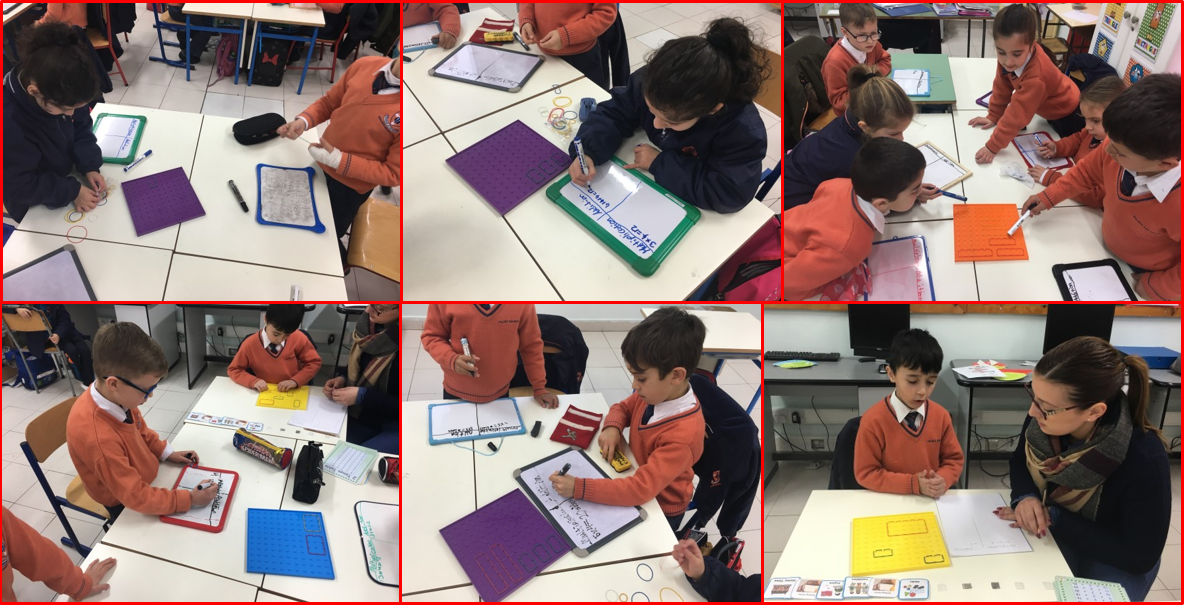
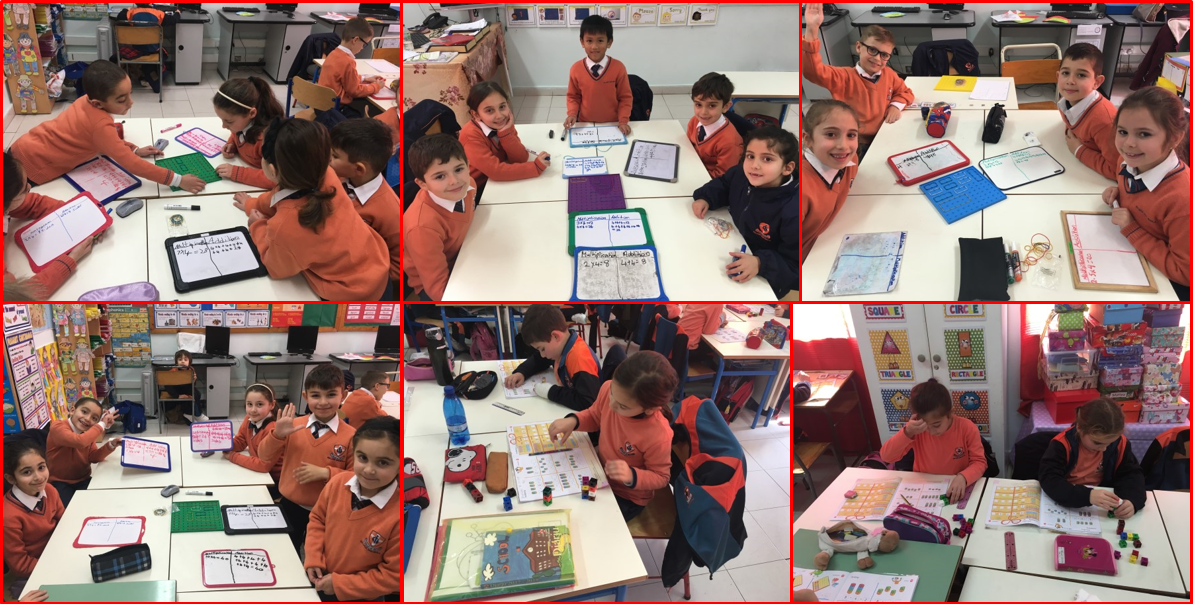
In order to understand the operation of multiplication as repeated addition children took part in various hands on activities. Students are engaged and understand better when using manipulatives. As the photos show, they enjoy learning this subject. Maths can be fun after all 🙂
Submitted by Ms Miranda Cauchi, Yr 3.1 Class Teacher
The class was divided in stations. Each station was given a container filled with the following: coins, pins, paper clips and butterfly pins. Students had to write (on their mini whiteboards) how many they thought there were in each container without counting; thus estimating (guessing).
After, students were asked to say what made them guess that number (their observations). Some noted that since coins are larger than pins they came to the conclusion that there were less coins. Others noticed that even though two of the containers were the same, one was filled slightly more.
Finally, they counted the objects found in each container to check their estimate. Furthermore they linked what they were doing in class with the outside world as they noticed that sometimes in competitions people have to estimate how many balloons, tickets …are there in a box.
Each group was given some plasticine and cooking cutters. Each member of the group had to divide his/her shape in half. The students pointed out that both halves had to be of the same size and when they were once put together they made one whole. Some students also realized that when the halves of the shapes are halved again they become quarters. Then, each group had to cut the given paper shapes in half and glue them on their copybooks.
In another lesson, in groups, students had to tick whether the pictures of the given real life objects were divided in half. They also had to divide other real life objects in half and draw an object/thing and hen divide it in half as well. Students also did similar activities on the IWB.
This week students have been learning about prepositions. Two groups were given a supermarket picture and question cards. The questions were about the position of things and people found in the picture. Students had to write their answers on their mini whiteboards. The other groups had to programme the Bee-Bot correctly so that it would stop on the correct picture according to the given flashcard.
During the English Creative writing lessons students had to write instructions on how to make a jam sandwich. First, students prepared the sandwich themselves. Whilst preparing the sandwich, the students started saying the instructions orally. They sued short simple sentences, bossy verbs and sequencer words, without even knowing that they to do so when writing a set of instructions. Therefore they learned by doing. After eating their delicious sandwich, the students wrote the instructions.