Capacity investigations

First- an explanation was done to help students remember how to convert l to ml and vice versa. An investigation was then carried out by myself using measuring containers and students were asked to observe the different questioning techniques.


Then, using measuring containers in groups, the students were given the opportunity to create their own investigation using liquids while emphasizing the concept of liters and milliliters. After creating their problems and using the necessary amounts of water in the containers, they went around and solved the investigations that the other groups had laid out for them in stations.

Submitted by Mr Matthew Cassar, Yr 6.1

Sillabi…

Din il-ġimgħa, it-tfal tal-ewwel sena kienu qegħdin jitkellmu dwar is-sillabi u kif ser jinqasmu biex jgħinuhom fil-qari. Huma għarfu li f’kull sillaba jkun hemm vokali waħda u l-ittri doppji qatt ma jistgħu ikunu fl-istess sillaba. Dan sar kollu b’eżerċizzju ħafif meta bl-imqass qasmu numru ta’ leħħiet li kienu għamlu huma stess.

Xogħol ta’ Ms Marilyn Buġeja, Għalliema tal-ewwel sena

Visit at the Grocer

K1.3 pupils of Ms Nagaat Bugeja were taken to the greengrocer shop next to the school to practice numeracy skills.  They followed a simple and short shopping list to make a purchase whilst practising number recognition and value.

Pupils enjoyed making fruit kebabs with the purchased fruit.

Submitted by Ms Borg Vella, Assistant Head

Maths Trail at School

Today Year 1 children participated in a school Maths trail.

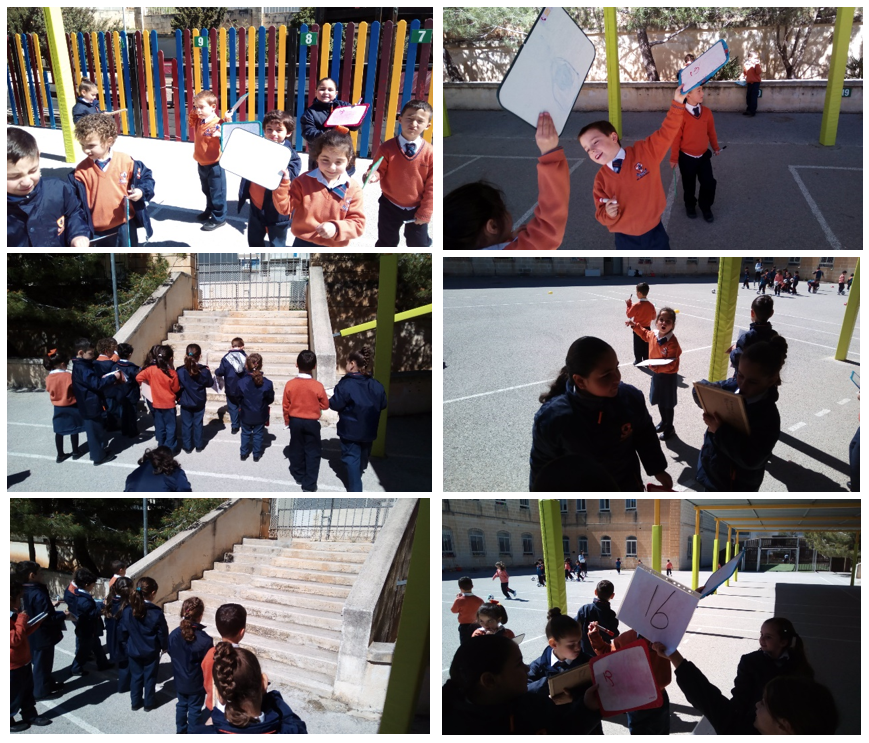
They went round the school to count steps, find shapes, count fire extinguishers, observe height of trees and objects, and order numbers amongst other activities.

Whilst learning numeracy, the students enjoyed the outdoors.

This activity provided for a meaningful hands-on experience.

Submitted by Ms Marilyn Bugeja, Yr 1.1 Class Teacher

Tick Tock! Tick Tock!

Learing about ‘Time’ using the CPA (concrete, practical, abstract) approach. Clocks from the Maths Class Toolbox were used as a tangible resource to help students understand the 24 hour clock better. A tablet game with pictures of clocks on it was then used as a consolidation of the previous explanation. A memory game was carried out in groups where students were asked to match the 24 hour clock time with the 12 hour clock time.
Submitted by Mr Matthew Cassar, Yr 6.1 Class Teacher

Walking Water & Mixing Colours

We started the experiment by filling up 4 clear cups with coloured food colour (Red, yellow, blue and another one with red) and put them about 4 inches apart. Then we put another 3 clear empty cups in between. We grabbed 6 strips of paper towels and placed one end of the each paper towel into the glass with the water and the other end into an empty cup. We repeated this for every cup, thus having 2 paper towel strips in the empty cups. We left the cups sit for a few hours and check on them every hour to see what happened.

The children learnt that water travels up and across the paper towel out of one glass and into another. They could see that the coloured water in the empty cup was a mixture of both adjacent cups’ water.  They learnt that red and yellow made orange, yellow and blue made green, blue and red made purple.

Later on during the week children were given some 3 cups of coloured water – red, blue, yellow and they were asked to create a painting on paper towels. They could see that when the colours touched they changed their initial colour – thus mixing into a secondary colour.

Submitted by Ms Marilyn Bugeja, Yr 1.1 Class Teacher

Weight

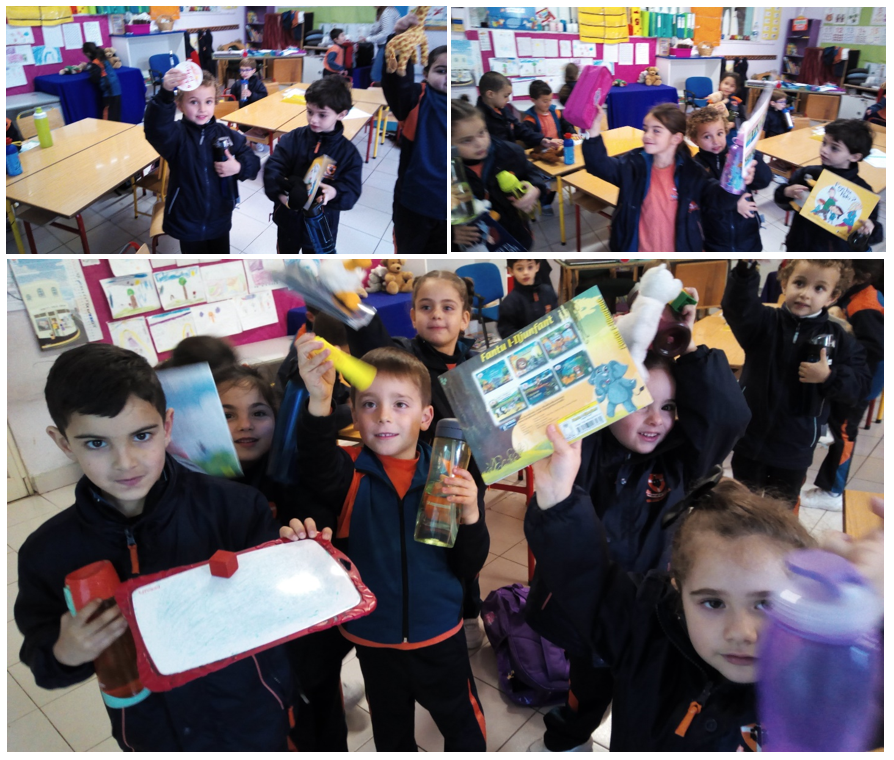
In class we introduced the topic ‘Weight’. After talking about what they knew about the topic, children were asked to take out their drinking bottles and go around the class to find objects which were lighter and heavier than their bottles. They enjoyed this hands on activity as they could clearly understand the difference between heavier and lighter.

Submitted by Ms Marilyn Bugeja, Yr 1.1 Class Teacher

Outdoor Estimation

Today we went outside to estimate the number of objects we have in the school yard. Children estimated the number of trees, steps, number of windows. They wrote their estate on the whiteboard and then counted to check the exact amount of objects.

Submitted by Ms Marilyn Bugeja, Yr 1.1 Class Teacher